
In this guide, I’ll show you the best VR treadmills that you can actually purchase today and play games in virtual reality with. most of these options are omnidirectional treadmills that let you move in full 360 degrees, but there are a few interesting budget options too!
Let me know what your favorite VR treadmill is below.
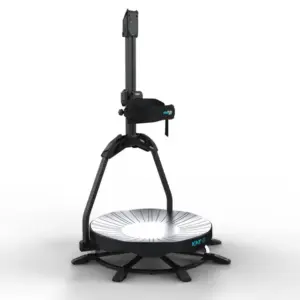
Best overall: the KAT Walk C2 Core.
At around $799, it’s the cheapest way to get a real omnidirectional walking deck with a harness, and it works with both SteamVR and Meta Quest (via the KAT Nexus adapter). If you want haptic feedback and a quieter motor, step up to the KAT Walk C2+ Enhanced. If you don’t have the floor space or budget for a full deck, the $229 KAT Loco S skips the platform entirely and still tracks real walking.
Compare VR Treadmills at a Glance
| Product | Price | Mechanism | Footprint | Best For |
|---|---|---|---|---|
| KAT Walk C2 Core | ~$799 | Frictionless deck + harness | ~1.2 m² / 13 sq ft | Best Overall |
| KAT Walk C2+ Enhanced | ~$1,199 | Frictionless deck + harness + haptics | ~1.23 m² / 13.2 sq ft | Best for Haptic Feedback |
| Virtuix Omni One | ~$2,595 | Harness + slide-shoe platform | ~4 ft diameter | Best for Full-Body Movement |
| KAT Loco S | ~$229 | Wearable leg sensors, no platform | None (any floor) | Best Budget Pick |
| Cyberith Virtualizer Elite 2 | Quote-only | Powered motion platform | Not published | Best Commercial-Grade |
How We Picked The Best VR Treadmills
Every product on this list is currently in production and buyable today, not a Kickstarter promise or a discontinued unit still floating around older “best of” lists (more on that below).
We pulled pricing and specs straight from each manufacturer’s own product pages rather than reusing numbers from other roundups, and we’ve deliberately grouped these by how they actually work, because “VR treadmill” covers several genuinely different pieces of hardware, not one product category.
If you want the deeper hands-on background on KAT VR’s earlier single-deck model, see our Kat Walk C review.
We also included Cyberith’s Virtualizer Elite 2 even though it’s not a realistic home purchase. It’s a real, current product built around a different mechanism (a powered motion platform instead of a passive frictionless deck), and leaving it out to make this list look like a tidier consumer roundup would mean skipping the one option built for serious commercial and rehab use.
KAT Walk C2 Core (Best Overall)
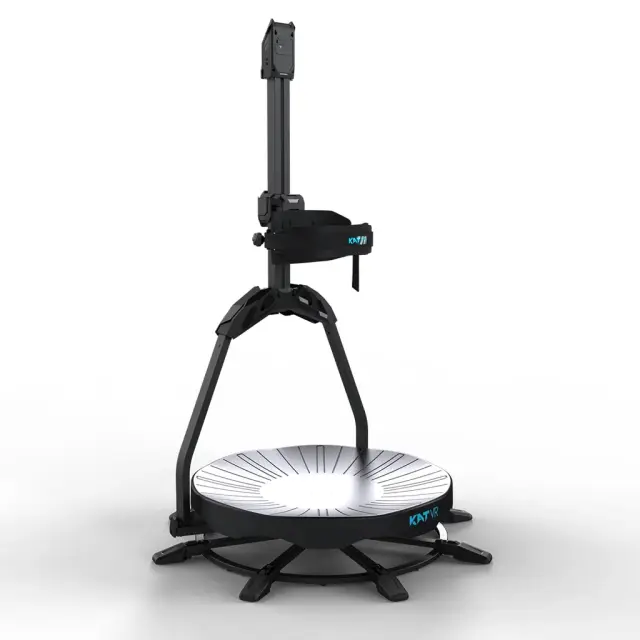
The KAT Walk C2 Core is the cheapest way into a real omnidirectional VR treadmill, and it’s currently the default recommendation for anyone asking “which VR treadmill should I actually buy.” You stand on a low-friction, concave deck wearing KAT’s own frictionless shoes, secured by a waist-height harness that lets you walk, crouch, and turn 360 degrees without your feet ever leaving the platform’s center.
It isn’t stripped-down in the ways that matter. KAT VR’s own spec sheet lists sub-10ms input latency and 360° optical tracking accurate to under a third of a degree, which is why walking on it feels closer to natural movement than swinging a joystick.
The catch is that the sit-down module (useful for driving and flight sims) is sold separately here, and Meta Quest support requires KAT’s Nexus adapter rather than working natively out of the box. Still, this is the best VR treadmill you can buy today.
Pricing
Currently listed around $799 against a $1,497 regular price. KAT VR runs frequent sales, so treat $799 as a typical price rather than a guaranteed one, and check the current listing before buying.
Buy from KAT VR | Also on Amazon
Compatibility
SteamVR and Oculus Home natively; Meta Quest 2, 3, and Pro via the KAT Nexus adapter. Also works with HTC Vive/Vive Pro, Valve Index, Pimax, and Windows Mixed Reality headsets. KAT VR lists over 1,000 compatible games.
PROS
- Lowest price of any full deck-and-harness treadmill on this list
- Sub-10ms latency and sub-millimeter tracking accuracy on paper
- Compact footprint (about 13 square feet) fits in a bedroom corner
- Harness lets you crouch and stand without fear of stepping off the platform
CONS
- Sit module costs extra
- Meta Quest needs the Nexus adapter, not native support
- Shoes have a break-in period before the frictionless glide feels natural
KAT Walk C2+ Enhanced (Best for Haptic Feedback)
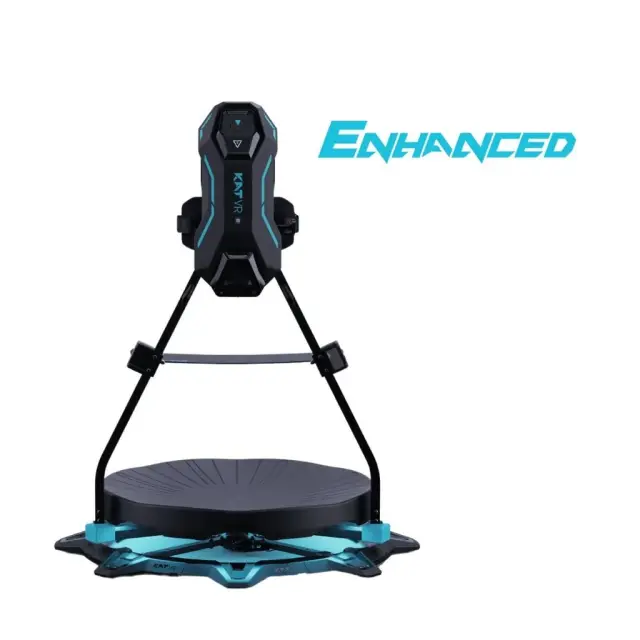
The C2+ Enhanced is the same core deck-and-harness mechanism as the C2 Core, built up into KAT VR’s flagship consumer model. The headline upgrade is a haptic feedback system built into the platform itself, so footsteps, impacts, and terrain changes in supported games register as real feedback through your feet rather than just sound and visuals.
KAT VR also addressed the two most common complaints about earlier treadmills here: noise and shock. The Enhanced model claims a 36.9% quieter motor (branded K-Quiet Tech) and 35% more shock absorption (K-Walk Tech), which matters more than it sounds like it should if you’re playing in an apartment or a shared house. It ships with the sit module included, along with built-in wheels for moving the unit between rooms, neither of which the cheaper Core gets by default.
Pricing
Currently listed around $1,199 against a $1,598 regular price, occasionally lower with promotional codes. As with the Core, confirm the live price before buying since KAT VR discounts move around.
Buy from KAT VR | Also on Amazon
Compatibility
Same platform support as the C2 Core (SteamVR, Oculus Home, Meta Quest via Nexus adapter, plus Vive, Index, Pimax, and WMR headsets). Supports users from 5’1″ to 6’7″ and up to 286 lbs.
PROS
- Haptic feedback adds real sensation, not just a marketing checkbox
- Noticeably quieter and smoother than the base C2 Core
- Sit module and transport wheels included in the box
- Wider height and weight range than the Core
CONS
- Roughly $400 more than the Core for the haptic upgrade
- Still needs the Nexus adapter for Quest
- Bigger footprint than the Core once you account for the stabilizing feet
Virtuix Omni One (Best for Full-Body Movement)
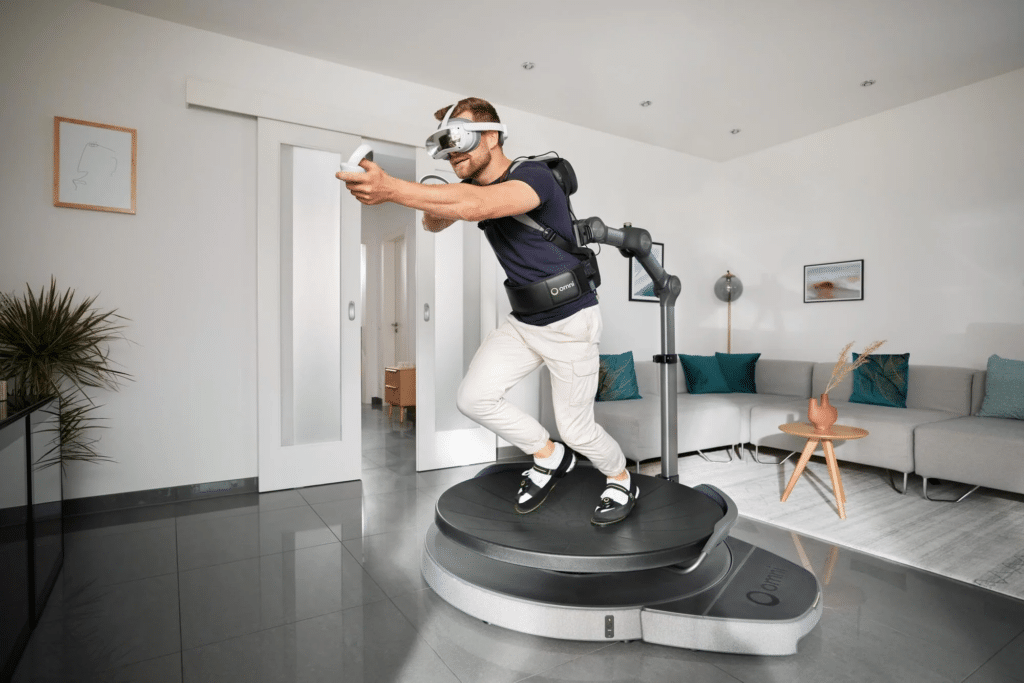
The Omni One takes a different approach than KAT’s frictionless deck. You’re strapped into a support ring with a low-friction concave platform under specialized overshoes, and the design is built specifically to let you run, jump, and crouch, not just walk, in ways the flatter KAT decks don’t emphasize as heavily. Virtuix’s own materials lean into full-body cardio (it tracks steps, distance, and calories), and the hardware backs that up: a 250 lb weight capacity and a 4’4″ to 6’4″ height range cover most adult users.
It’s also the most expensive item on this list by a wide margin, and the footprint is bigger too, at roughly 4 feet wide by 5 feet deep. That’s a real commitment of floor space and money for what’s ultimately still a single-purpose device. Virtuix does offer a payment plan (roughly $70 to $90 a month depending on term) if the $2,595 upfront price is the blocker rather than the size.
Pricing
Around $2,595 at current intro pricing (list price $3,495), or a monthly payment plan in the roughly $70 to $90 range. Includes overshoes, foot trackers, and a cleaning kit.
Buy from Virtuix (not currently sold on Amazon)
Compatibility
Built for Meta Quest 2 and Quest 3.
PROS
- Genuinely supports running and jumping, not just walking
- Highest weight capacity and widest height range on this list
- Includes overshoes and trackers in the box, no separate shoe purchase
- 30-day refund window and 12-month warranty
CONS
- Most expensive consumer option here by a large margin
- Biggest footprint of any home unit on this list
- Quest-only; no native SteamVR/PCVR support on this version
KAT Loco S (Best Budget Pick)
The Loco S skips the platform entirely. It’s a set of three wireless sensors, two for your ankles and one for your lower back, that track your leg movement while you walk in place on your own floor, no deck, no harness, no dedicated square footage beyond the room you’re already standing in.
That makes it the cheapest and most apartment-friendly option here by far, and the only one you could reasonably pack in a bag.
The tradeoff is exactly what you’d expect: without a physical platform, there’s nothing stopping you from drifting forward as you walk in place, and the immersion isn’t in the same league as strapping into a full harness and deck. KAT VR pitches it honestly as a fitness-and-locomotion accessory rather than a treadmill replacement, and at 250 compatible games it has real software support, even if it’s a third of what the full C2 series lists.
Pricing
Around $229, up slightly from its original $199 launch price.
Buy from KAT VR | Also on Amazon (KAT VR storefront)
Compatibility
Meta Quest (via the optional KAT Nexus adapter for standalone use), SteamVR, and Oculus PCVR. Roughly 250 compatible games.
PROS
- Cheapest real locomotion device on this list by a wide margin
- No dedicated floor space required
- Portable, wireless, 7-hour battery life
- One-second calibration, no magnetic setup
CONS
- No physical barrier to stop you drifting while walking in place
- Meaningfully less immersive than a full deck-and-harness treadmill
- Smaller compatible game library than the KAT Walk series
Cyberith Virtualizer Elite 2 (Best Commercial-Grade)
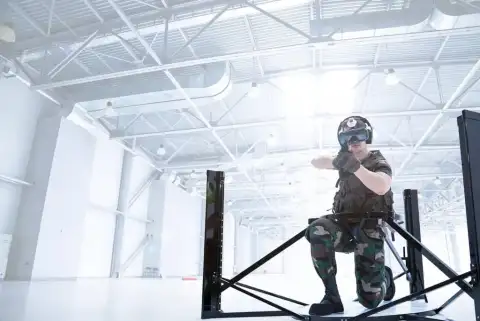
The Virtualizer Elite 2 is built around a powered motion platform rather than a passive frictionless surface, which means the hardware itself actively supports your gait instead of just reducing friction under your feet.
Cyberith markets it toward research and development, location-based entertainment, training and simulation, and rehabilitation, and the spec sheet backs that up: a vibration haptic unit in the baseplate, an automatic safety ring lock you can disable for full freedom of movement, and an open-source SDK for custom integration work.
None of that is aimed at a home buyer, and Cyberith doesn’t publish consumer pricing on the product page, you have to contact them directly for a quote. Older sourcing puts a bundled Elite 2 package (with an HTC Vive included) around $11,000, which lines up with a professional/institutional buyer rather than a home setup. We’re including it here because it’s a real, current, meaningfully different product, not because it belongs on most people’s shortlists.
Pricing
Not publicly listed. Contact Cyberith directly for a commercial quote; historical bundled pricing has been in the five-figure range.
View on Cyberith (quote-only, not sold on Amazon)
Compatibility
Compatible with most major VR headsets; built with an open-source SDK for custom/commercial integrations.
PROS
- Powered motion platform actively supports natural gait, a different mechanism from every other product here
- Built-in haptic feedback and a disable-able safety lock
- Aimed at professional use cases (rehab, training, R&D) that consumer decks aren’t designed for
CONS
- No public consumer pricing, historically five figures
- Not a realistic purchase for a home user
- Overkill for anyone just wanting to play VR games at home
What to Know Before You Buy
Space and Footprint
The KAT Walk decks need roughly 11 to 14 square feet of dedicated floor space (call it a 4-foot circle), plus another 5 to 6 feet of clearance around that for safety and cable/headset tracking room. The Omni One needs closer to a 4-by-5-foot footprint.
None of these best VR treadmills are furniture you tuck away after a session, so measure your actual room before ordering, not just the unit’s stated footprint, since the harness and support arm both swing outward as you move.
Watch Out for Discontinued Products in Other “Best VR Treadmill” Lists
If you’ve read other roundups on this topic, you may have seen Cybershoes recommended as the budget pick. It isn’t available anymore: the company behind it shut down in April 2025, after production had already stopped roughly two years earlier.
A number of still-published “best of 2026” articles haven’t caught up to that, and the same is true of 3dRudder, another once-popular foot controller whose parent company has also folded. If a VR treadmill article you’re reading recommends either one, that’s a good sign the rest of its pricing and availability info is stale too.
Does a VR Treadmill Actually Reduce Motion Sickness?
Yes, for most people, and it’s the main reason these exist. VR sickness largely comes from a mismatch between what your eyes see (you’re moving) and what your inner ear feels (you’re standing still), which is exactly what happens with joystick-based smooth locomotion.
Physically walking, even in place, closes that gap, because your body is now doing something that matches what you’re seeing.
Frequently Asked Questions
What is a VR treadmill?
A VR treadmill is a device that lets you physically walk, and on some models run, crouch, or jump, while a VR headset tracks that movement as in-game locomotion. Unlike a normal treadmill, most VR treadmills use a low-friction deck or platform that lets you move in any direction, not just forward, which is why they’re usually called “omnidirectional.”
Do I need a gaming PC to use a VR treadmill?
Not necessarily. The KAT Walk C2 series and the Loco S both work with Meta Quest headsets through KAT’s Nexus adapter without a PC, in addition to full SteamVR/PCVR support. The Virtuix Omni One is built specifically for Meta Quest 2 and 3, also without requiring a PC.
How much does a VR treadmill cost?
Entry-level locomotion accessories like the KAT Loco S start around $229. Full deck-and-harness treadmills start around $799 for the KAT Walk C2 Core and run up to roughly $2,595 for the Virtuix Omni One. Commercial-grade units like the Cyberith Virtualizer Elite 2 aren’t publicly priced and run well into five figures.
Is the KAT Walk C2 Core worth it over the cheaper KAT Loco S?
It depends on what you want. The C2 Core gives you a real platform and harness, which feels closer to actually walking and lets you turn and move without drifting. The Loco S is a fraction of the price and needs zero dedicated floor space, but the sensation is closer to jogging in place than walking through a virtual space. If budget and apartment space are tight, start with the Loco S; if immersion is the priority, save for the C2 Core.
Final Verdict
For most people, the KAT Walk C2 Core is the best VR treadmill: it’s the least expensive way to get a real omnidirectional deck and harness, and it works with both SteamVR and Meta Quest.
If you want haptic feedback and a quieter, smoother motor and don’t mind paying roughly $400 more, step up to the KAT Walk C2+ Enhanced. If floor space or budget rules out a full platform, the KAT Loco S gets you real walking-based locomotion for about a quarter of the price of the cheapest deck.