

Which Meta glasses should you buy? Meta now sells eight different lines of AI glasses across three brands (Ray-Ban, Oakley, and its own Meta Glasses), with prices running from about $224 to $799.
I’ve covered Meta’s glasses since the original Ray-Ban Stories and demoed the newest Meta Gen 3 models at Meta Connect, so in this guide I’ll break down every model, what actually separates them, and which one fits how you’ll use it.
Quick Answer: Which Meta Glasses Are Best?
- Best overall: Ray-Ban Meta Gen 3 ($449)
- Best without a camera: Ray-Ban Meta Audio ($349)
- Best value: Meta Glasses such as the Adventurer ($299, or $249 for the basic black version)
- Best for sports: Oakley Meta Vanguard ($499)
- Best with a screen: Meta Ray-Ban Display ($799)
- Cheapest way in: Ray-Ban Meta Gen 1 (often around $224 on sale)
So which Meta glasses should you buy? Get Gen 3 if you want the best all-rounder with a camera, and the Audio pair if you just want music, calls, and Meta AI without a camera on your face.
Meta Glasses Comparison Chart: Every Model Side by Side
Here’s how all eight current Meta glasses compare on the specs that matter most when deciding which Meta glasses you should buy. Prices are US starting prices.
| Model | Price | Camera | Battery (glasses) | Mics | Action button | Water rating | Prescription |
|---|---|---|---|---|---|---|---|
| Ray-Ban Meta Gen 3 | $449 | 12MP, 3K video | Up to 9 hours | 6 | Yes | Not yet published | Yes |
| Ray-Ban Meta Audio | $349 | None | Up to 12 hours | 6 | Yes | Not yet published | Yes |
| Meta Glasses (Adventurer, Fury, Nova, Capri) | $299 ($249 basic Adventurer) | 12MP, 3K video | 8+ hours | 6 | Yes | Not yet published | Yes |
| Oakley Meta Vanguard | $499 | 12MP ultra-wide, centered, 3K video | Up to 9 hours | 5 (wind-optimized) | Yes | IP67 | No |
| Oakley Meta HSTN | From $399 | 12MP, 3K video | Up to 8 hours | 5 | No | IPX4 | Yes |
| Meta Ray-Ban Display | $799 | 12MP, 1080p video | Up to 6 hours | 6 | No | Not yet published | -4.00 to +4.00 only |
| Ray-Ban Meta Gen 2 | $379 | 12MP, 3K video | Up to 8 hours | 5 | No | IPX4 | Yes |
| Ray-Ban Meta Gen 1 | Around $224 to $299 | 12MP, 1080p video | Up to 4 hours | 5 | No | IPX4 | Yes |
Every model has open-ear speakers, voice control, Meta AI, and a charging case. The differences come down to the camera, battery, fit, and what each frame is built for.
What’s the Difference Between Meta Glasses? Ray-Ban Meta vs Oakley Meta vs Meta Glasses
Meta makes its AI glasses with EssilorLuxottica, the eyewear company behind Ray-Ban and Oakley. That’s why there are three brand names on essentially the same core technology: a 12MP camera (on most models), open-ear speakers, a mic array, and Meta AI.
- Ray-Ban Meta is the classic lifestyle line: Wayfarer, Aviator, Zena, and the camera-free Audio frames.
- Oakley Meta is the sport line: wraparound and athletic frames, Prizm lenses, and tougher water resistance on the Vanguard.
- Meta Glasses is Meta’s own brand, launched in 2026 as a cheaper way in, with frames like the Adventurer, Fury, Nova, and Capri.
- Meta Ray-Ban Display sits on its own as the only pair with a screen in the lens.
Meta Glasses vs Ray-Ban Meta: Is the Ray-Ban Name Worth It?
This is the most common point of confusion. Meta Glasses” are Meta-branded frames, while “Ray-Ban Meta” glasses carry the Ray-Ban name. On paper, the $299 Meta Glasses beat the $379 Ray-Ban Meta Gen 2: they have a sixth microphone, the customizable action button, and more fit adjustments (3-way adjustable nose pads, adjustable temple tips, and overextension hinges).
What you pay extra for with Ray-Ban is the look. If you’ve always wanted a Wayfarer or Aviator, go Ray-Ban. If you just want good AI glasses for the money, Meta Glasses give you more for less.
Oakley Meta vs Ray-Ban Meta: Which Is Better?
Oakley Meta is better if you sweat, ride, or spend long days outside. The Vanguard is rated IP67 (dust-tight and rated to survive submersion), has a centered ultra-wide camera for point-of-view video, and works with Garmin and Strava. Ray-Ban Meta is better for everyday wear: it looks like normal glasses, comes in more styles, and Gen 3 has the newer six-mic array and a longer battery than the Oakley HSTN.
A simple rule: if you’d normally reach for a pair of Oakleys for the activity, get Oakley Meta. For everything else, Ray-Ban Meta or Meta Glasses fit better.
Which Meta Glasses Are the Newest?
The newest Meta glasses are Ray-Ban Meta Gen 3 (on sale now), Ray-Ban Meta Audio (shipping October 13), the $249 basic Meta Adventurer (shipping October 23), and new Meta Glasses styles like Nova and Capri. All of them were announced or expanded at Meta Connect in September.
Ray-Ban Meta Gen 3 (Best Overall)
Ray-Ban Meta Gen 3 is the pair I’d tell most people to buy. It keeps everything that made Ray-Ban Meta glasses popular (a 12MP camera with 3K video, open-ear speakers, and Meta AI) and fixes the two things owners complained about most: battery life and call quality. You now get up to 9 hours on a charge, plus up to 50 more hours from the case, and a six-mic array that Meta says cuts more than 90% of background noise.
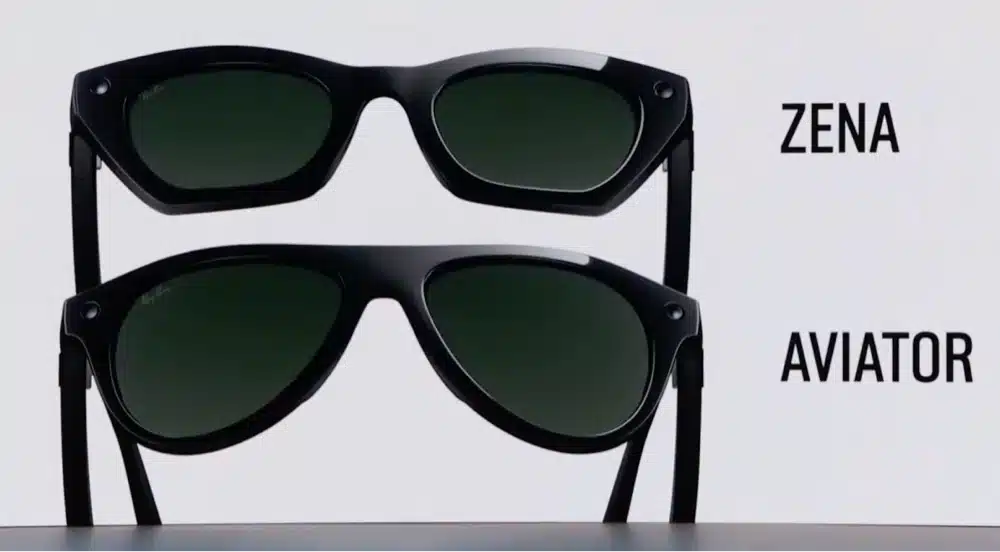
Gen 3 also adds the customizable action button, which you can set to trigger Meta AI or a shortcut, and it can record 360-degree spatial audio with Dolby Atmos alongside your video. It comes in the classic Wayfarer (standard and large sizes) plus two new shapes: the bigger Aviator and the narrower cat-eye Zena. The one thing it doesn’t have is the adjustable nose pads you get on Meta Glasses and the Audio frames.
Pricing
Ray-Ban Meta Gen 3 starts at $449 from Meta and Amazon. Prescription, polarized, and Transitions lenses cost extra, and limited editions like the Warm Beige Aviator run $549.
Pros
- Best mix of camera, audio, and battery in the Ray-Ban line
- Six-mic array makes calls noticeably clearer outdoors
- Up to 9 hours of battery plus 50 more from the case
- Customizable action button
- Classic Ray-Ban styles, including a large Wayfarer
Cons
- $70 more than Gen 2 and $150 more than Meta Glasses
- No adjustable nose pads
- Zena only comes in one size
Ray-Ban Meta Audio (Best Without a Camera)
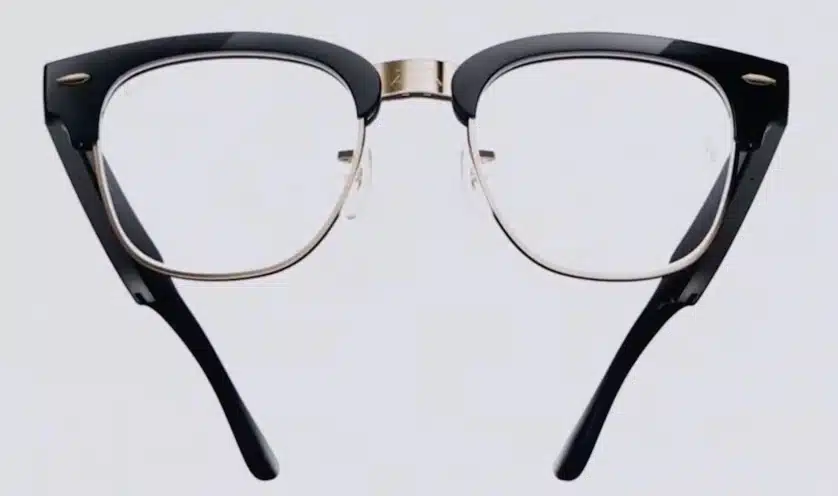
Ray-Ban Meta Audio is Meta’s first pair with no camera at all. You still get open-ear speakers, the same six-mic array as Gen 3, the action button, and Meta AI by voice, so you can play music, take calls, translate conversations, and ask questions. What you lose is photos, video, and any AI feature that needs to see what you’re looking at.
In exchange, you get the longest battery life of any Meta glasses (up to 12 hours, plus 48 more from the case) and the lightest frame Meta makes at 43 grams. When I tried them at Connect, they felt much closer to regular sunglasses than to a gadget. They’re also the easiest pair to wear somewhere camera glasses make people uneasy. I go deeper in my Ray-Ban Meta Audio vs Gen 3 comparison.
Pricing
Ray-Ban Meta Audio starts at $349 and ships October 13. It comes in two frames: the retro Clubmaster (with a low bridge fit) and the squarer Burbank (standard and large sizes).
Pros
- Longest battery life of any Meta glasses
- Lightest Meta frame at 43 grams
- No camera, so no privacy concerns for the people around you
- Adjustable temple tips and nose pads for a better fit
Cons
- No photos, video, or visual AI
- Only two frame styles
Meta Glasses: Adventurer, Fury, Nova and Capri (Best Value)
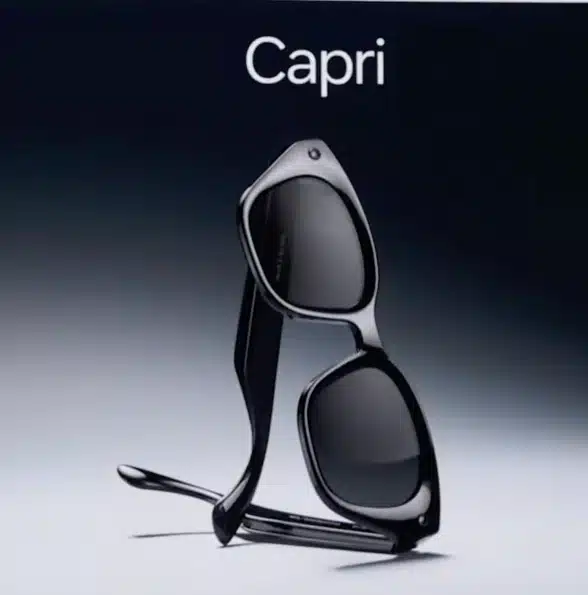
Meta Glasses are Meta’s own-brand AI glasses, and they’re the best deal in the lineup. At $299 you get the same 12MP camera and 3K video as Ray-Ban Meta Gen 3, a six-mic array, the action button, and 8+ hours of battery. They also have the best fit adjustments of any camera model: 3-way adjustable nose pads, adjustable temple tips, and overextension hinges.
Meta also sells a basic Meta Adventurer (black frame, grey lenses, plug-in case) for $249, which is the cheapest new pair of Meta camera glasses. Special editions include the Meta Starfire by Kylie Jenner ($399), which is the only pair with Kylie’s voice for Meta AI, and LISA editions of the Adventurer and Capri ($399) with collectible charms.
Meta Adventurer vs Fury vs Nova vs Capri
All four share the same tech, so this is purely about the frame:
- Adventurer is a classic rectangle in standard and large sizes, the safest pick and the closest to a Wayfarer.
- Fury is a bold square frame with thick rims, for when you want the frame to stand out.
- Nova is a round frame in small and standard sizes, and the best Meta option for smaller faces.
- Capri is a cat-eye frame with a more fashion-forward look.
If you’re weighing the Meta Adventurer vs Ray-Ban Wayfarer Gen 2, the Adventurer wins on features (six mics, action button, adjustable fit) and costs $80 less. The Wayfarer wins on the Ray-Ban name and look.
Pricing
Meta Adventurer, Fury, Nova, and Capri start at $299 from Meta. The basic black Adventurer is $249 and ships October 23. Starfire by Kylie and LISA editions are $399.
Pros
- Same camera as Gen 3 for $150 less
- Best fit adjustments of any Meta camera glasses
- Six mics and the action button
- Nova comes in a small size
Cons
- No Ray-Ban or Oakley branding
- Battery is a little shorter than Gen 3
Oakley Meta Vanguard (Best for Running, Cycling and Golf)
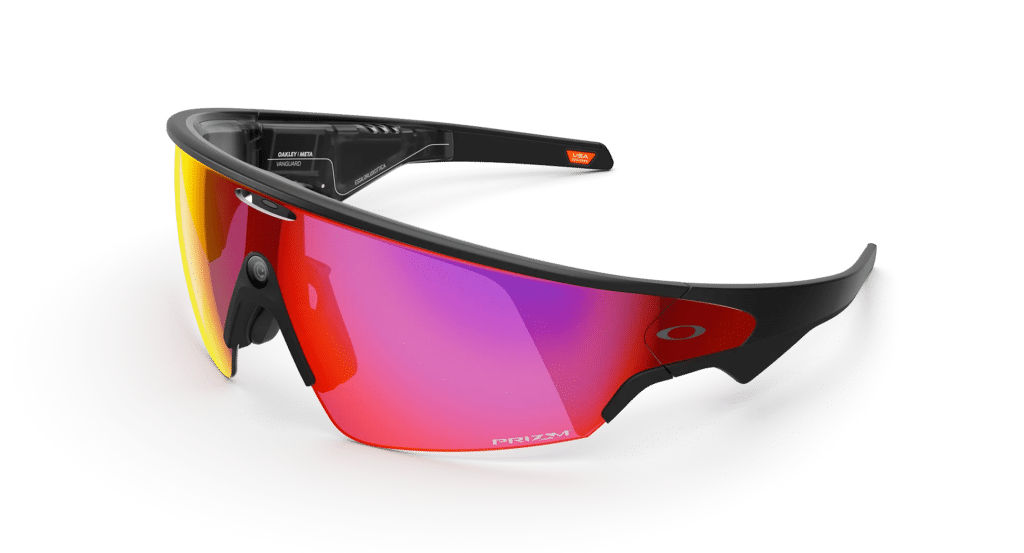
The Oakley Meta Vanguard is built for athletes. Its 12MP camera sits in the center of the frame with a 122-degree ultra-wide field of view, so your point-of-view footage looks level instead of shot from the side of your head like other Meta glasses. It’s rated IP67, it has a wind-optimized five-mic array so calls work at speed, and it connects to Garmin and Strava so your stats can show up on your recordings.
You get up to 9 hours of battery, the action button, Prizm lenses, and a wraparound fit that stays put when you run. The big catch: Vanguard doesn’t support prescription lenses, so it’s only for people who don’t need vision correction or who wear contacts.
Oakley Meta HSTN vs Vanguard
Pick Vanguard for serious running, cycling, skiing, or mountain biking, where the centered camera, IP67 rating, and wraparound fit matter. Pick HSTN if you want something that works at the gym or on the golf course but still looks normal at lunch, or if you need prescription lenses.
Pricing
Oakley Meta Vanguard costs $499 from Oakley and Meta. It comes with both high and low bridge nose pads in the box.
Pros
- Centered 122-degree camera for true point-of-view video
- IP67 rating, the toughest of any Meta glasses
- Garmin and Strava integration
- Up to 9 hours of battery
Cons
- No prescription lenses
- Sporty look isn’t for everyday wear
- Most expensive pair without a display
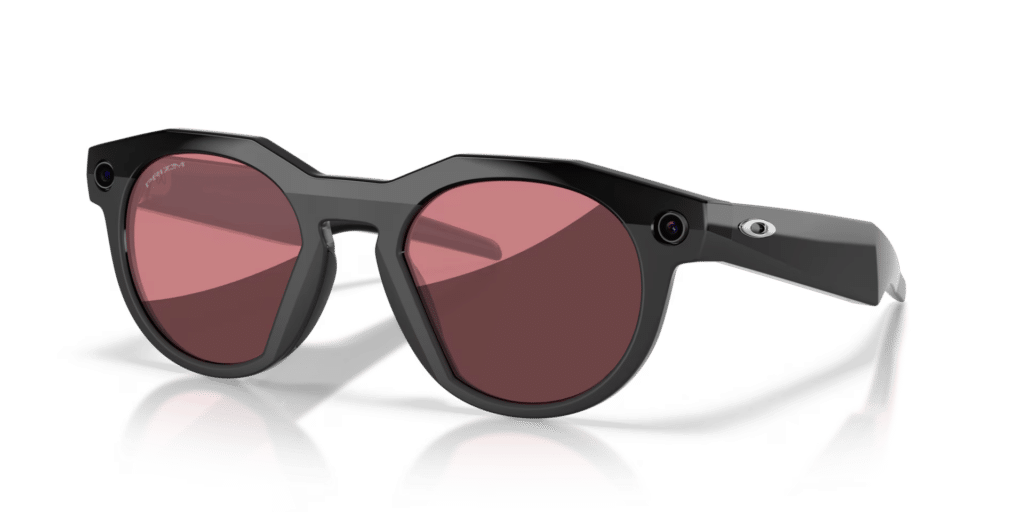
Oakley Meta HSTN (Best for Active Everyday Wear)
The Oakley Meta HSTN is the middle ground between Ray-Ban and Vanguard. It looks like a normal pair of Oakley sunglasses, supports prescription lenses, and comes with Prizm, polarized, Transitions, or clear lenses. It’s rated IPX4, so sweat and rain aren’t a problem.
Under the hood it’s close to Ray-Ban Meta Gen 2: a 12MP camera with 3K video, five mics, and up to 8 hours of battery with 48 more from the case. It doesn’t have the action button or the six-mic array found on the newest models, so it’s a sporty style choice more than a tech upgrade.
Pricing
Oakley Meta HSTN starts at $399 from Oakley, with Transitions and limited editions costing more.
Pros
- Sporty look that still works day to day
- Prescription and polarized Prizm lens options
- IPX4 sweat and water resistance
Cons
- Older five-mic array and no action button
- Costs more than Meta Glasses with fewer features
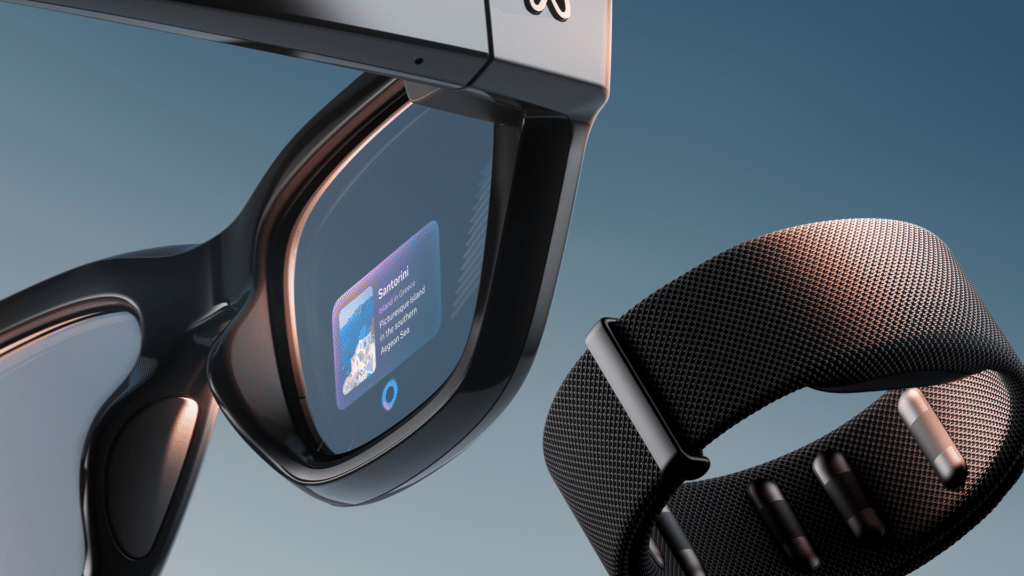
Meta Ray-Ban Display (Best With a Screen)
Meta Ray-Ban Display is the only Meta glasses with a screen. A small display in the right lens shows messages, navigation, live captions, translations, and a camera viewfinder, and you control it with the included Meta Neural Band, a wristband that reads small finger movements. I covered it in depth in my Meta Ray-Ban Display review.
The trade-offs are real. Battery life is up to 6 hours, video tops out at 1080p, prescriptions are limited to -4.00 to +4.00, and it costs almost twice as much as Gen 3. It’s the right pick if you want to glance at information without pulling out your phone, and overkill if you mostly want photos and music.
Pricing
Meta Ray-Ban Display costs $799 in the US, including the Neural Band. It comes in standard and large sizes with Transitions lenses.
Pros
- The only Meta glasses with an in-lens display
- Neural Band control feels natural once you get used to it
- Live captions and on-screen navigation
Cons
- $799 price
- Shortest battery life of the current models
- Limited prescription range
Ray-Ban Meta Gen 2 (Best If You Find It on Sale)
Ray-Ban Meta Gen 2 was the best pair to buy until Gen 3 arrived, and it’s still very good. You get the same 12MP camera and 3K video as Gen 3, up to 8 hours of battery, and the widest range of Ray-Ban styles, including Wayfarer, Skyler, Headliner, and the Blayzer and Scriber Optics frames designed for prescription wearers.
It lacks the sixth microphone and the action button, so calls in windy or loud places aren’t quite as clean. At full price it’s hard to recommend over the $299 Meta Glasses, but retailers often discount the older generation after a new one launches.
Ray-Ban Meta Gen 3 vs Gen 2
The difference between Meta glasses Gen 2 and Gen 3 is smaller than the name suggests: one more hour of battery (9 vs 8), a sixth mic, the action button, and new Aviator and Zena styles. If you already own Gen 2, there’s no urgent reason to upgrade.
Pricing
Ray-Ban Meta Gen 2 lists at $379 from Meta and Amazon.
Pros
- Same camera as Gen 3
- Widest choice of Ray-Ban styles, including Optics frames for glasses wearers
- Frequently discounted
Cons
- No action button
- Five mics instead of six

Ray-Ban Meta Gen 1 (Cheapest Way In)
Ray-Ban Meta Gen 1 is the cheapest way to get Meta AI glasses with a camera. It still does the basics well: photos, 1080p video, music, calls, and Meta AI, including live translation.
The catch is battery life. Gen 1 is rated for up to 4 hours, half of Gen 2, which means it can die before lunch if you listen to music all morning. Only buy it if you find a big discount and you’ll use it in short bursts.
Pricing
Gen 1 lists at $299 but is often discounted to around $224 at retailers like Amazon.
Pros
- Lowest price for Meta camera glasses
- Classic Wayfarer, Skyler, and Headliner styles
Cons
- Only about 4 hours of battery
- 1080p video instead of 3K
Which Meta Glasses Have the Best Camera for Recording Video?
For recording, the Oakley Meta Vanguard has the best camera. Its lens sits in the center of the frame with a 122-degree ultra-wide view, so your clips look like they were shot from your eyes instead of from your temple. That makes it the best Meta glasses for POV video, vlogging a run or bike ride, and filming sports.
For everyday content creation, Ray-Ban Meta Gen 3 is the pick. It records 3K video and captures 360-degree spatial audio with Dolby Atmos, so your TikToks and Reels sound as good as they look. Meta Glasses, Gen 2, and Oakley HSTN also record 3K video, while Gen 1 and Display top out at 1080p. None of the current Meta glasses record in 4K.
Meta’s camera glasses can also livestream to Instagram and Facebook straight from the glasses, which makes them a hands-free option for streaming a walk, a concert, or a fishing trip.
Which Meta Glasses Have the Longest Battery Life?
Ranked by rated battery life on a single charge:
- Ray-Ban Meta Audio: up to 12 hours
- Ray-Ban Meta Gen 3: up to 9 hours
- Oakley Meta Vanguard: up to 9 hours
- Meta Glasses (Adventurer, Fury, Nova, Capri): 8+ hours
- Ray-Ban Meta Gen 2: up to 8 hours
- Oakley Meta HSTN: up to 8 hours
- Meta Ray-Ban Display: up to 6 hours
- Ray-Ban Meta Gen 1: up to 4 hours
These are best-case numbers. Recording video drains every pair much faster than music or calls, so if you plan to film a lot, expect a lot less than the rated figure and top up in the case between sessions.
Which Meta Glasses Are Waterproof?
None of Meta’s glasses are fully waterproof in the sense of being made for swimming. The Oakley Meta Vanguard is the most water-resistant, with an IP67 rating that means it’s dust-tight and rated to survive brief submersion. Ray-Ban Meta Gen 2 and Oakley Meta HSTN are rated IPX4, which covers sweat, rain, and splashes, but not dunking them in a pool.
At launch, Meta hadn’t published ratings for Gen 3, Audio, or Meta Glasses, so treat them as splash-resistant and keep them out of the water. If you want Meta glasses for kayaking, fishing from a boat, or skiing, Vanguard is the safe pick.
Which Meta Glasses Have a Display? (Can You Watch Netflix or YouTube on Them?)
Only one pair of Meta glasses has a display: the Meta Ray-Ban Display. Its small screen in the right lens shows text messages, navigation, live captions, and a camera viewfinder. Every other model (Gen 3, Audio, Meta Glasses, Oakley, Gen 1, and Gen 2) has no screen at all.
You can’t watch Netflix or YouTube on Meta glasses in any real sense. The Display is built for quick glances, not for sitting through a movie. If watching video is the goal, look at display glasses like the XREAL One Pro, which put a large virtual screen in front of you. My best augmented reality glasses guide covers more options.
Which Meta Glasses Do Live Translation?
Every current Meta glasses model with Meta AI does live translation, including the camera-free Audio pair. You hear the translation through the speakers, and the other person can read your side of the conversation in the Meta AI app. Meta Ray-Ban Display goes further by showing the translation as text in the lens.
Language support varies by model and keeps expanding. Ray-Ban Meta covers around 20 languages, while Meta lists fewer for Oakley and the Display at launch. You can also download language packs to translate offline, which is handy when traveling.
Which Meta Glasses Fit Best? Small Faces, Big Heads and Low Nose Bridges
Fit matters more with smart glasses than regular ones, since the speakers need to sit near your ears.
Best Meta Glasses for Small Faces
The Meta Nova is the best Meta glasses for small faces because it’s the only camera model offered in a small size. The Zena (Gen 3) and Capri also have narrower shapes. Avoid the Aviator and large Wayfarer.
Best Meta Glasses for Big Heads and Wide Faces
Look for the large size, which Meta offers on the Ray-Ban Meta Wayfarer (Gen 2 and Gen 3), the Meta Adventurer, the Audio Burbank, and the Meta Ray-Ban Display. The Gen 3 Aviator is also a larger frame. Overextension hinges on Meta Glasses and the Audio frames flex outward instead of pinching, which helps with wider heads.
Best Meta Glasses for a Low Nose Bridge
If regular glasses slide down your nose, choose a frame with a low bridge fit or adjustable nose pads. The Ray-Ban Meta Audio Clubmaster and the Adventurer LISA Edition have a low bridge fit, Meta Glasses have 3-way adjustable nose pads, and the Oakley Vanguard includes both high and low bridge nose pads. Most Ray-Ban Meta camera frames, including Gen 3, use a high bridge fit with no adjustable pads.
Best Meta Glasses for Men and Women
Every Meta frame is unisex. Wayfarer, Aviator, Adventurer, and Fury suit a classic, squarer look, while Zena, Capri, Nova, and the Kylie Starfire lean toward rounder and cat-eye shapes. Pick by face shape, not by label: angular frames balance round faces, and rounder frames soften square ones.
Best Meta Glasses for Prescription Lenses
Almost every Meta pair supports prescription lenses, with two exceptions. The Oakley Meta Vanguard doesn’t take prescription lenses at all, and the Meta Ray-Ban Display only supports prescriptions from -4.00 to +4.00.
For glasses wearers, the best picks are Meta Glasses (their adjustable nose pads and temple tips help a lot with all-day wear), Ray-Ban Meta Audio (the lightest frame), and the Gen 2 Blayzer and Scriber Optics frames, which were designed as everyday prescription glasses. If you have a high prescription or astigmatism, check your exact prescription with Meta or an optical retailer before ordering, since availability varies by lens type and location.
Best Meta Glasses for Sports: Running, Cycling, Golf and Fishing
Running and Cycling
Oakley Meta Vanguard, easily. The wraparound fit stays put, the IP67 rating shrugs off sweat and rain, the wind-optimized mics keep calls usable at speed, and Garmin and Strava integration puts your stats on your footage.
Golf
Vanguard if you want to record swings from a true point-of-view angle, and Oakley Meta HSTN if you want a pair that looks normal in the clubhouse and takes prescription lenses. Either lets you take calls and play music between holes without earbuds.
Fishing
Choose a model with polarized lenses to cut glare off the water: Oakley Meta HSTN with Prizm Polarized lenses, or any Ray-Ban Meta or Meta Glasses frame with polarized sun lenses. For fishing from a boat or kayak, Vanguard’s IP67 rating gives you the most peace of mind.
Best Meta Glasses for Blind and Low-Vision Users
Meta’s camera glasses are useful for blind and low-vision users. Say “Hey Meta” and ask what’s in front of you, and the glasses can describe your surroundings or read mail, menus, and medication labels out loud. Say “Hey Meta, Be My Eyes” to start a hands-free video call with a sighted volunteer through the Be My Eyes app.
Any camera model works, and Ray-Ban Meta Gen 3 or Meta Glasses are the best picks today thanks to their newer mics and longer battery. Skip the Audio pair, since it has no camera. If you’re a legally blind US veteran, Meta is donating free Ray-Ban Meta glasses through the Blinded Veterans Association; you can request a pair at bva.org/glasses.
Best Meta Glasses for Hearing Loss
Meta is launching Hearing Enhancement, an FDA-cleared, over-the-counter hearing feature for adults with mild to moderate hearing loss. It uses the glasses’ microphones to boost the voice of the person in front of you. It comes with a 30-day trial, then costs a one-time $149.99 (HSA/FSA eligible), or it’s included with a Meta One subscription. It arrives in the US later this year on Meta Glasses first, then on Ray-Ban Meta Gen 3 and Ray-Ban Meta Audio.
If you’re deaf or hard of hearing, Meta Ray-Ban Display’s live captions show what people are saying as text in the lens, which no other Meta pair can do.
How to Choose the Right Meta Glasses
Still not sure which Meta glasses you should buy? Match your main use to a pick:
- Want the best all-round pair with a camera? Ray-Ban Meta Gen 3
- Don’t want a camera? Ray-Ban Meta Audio
- Want the most for your money? Meta Glasses (Adventurer, Fury, Nova, or Capri)
- Run, ride, or ski? Oakley Meta Vanguard
- Want sporty frames with prescription lenses? Oakley Meta HSTN
- Want a screen in the lens? Meta Ray-Ban Display
- Found a good deal on the older model? Ray-Ban Meta Gen 2
- Want the absolute lowest price? Ray-Ban Meta Gen 1, on sale
Whichever you pick, my best Ray-Ban Meta accessories guide covers cases, chargers, and lens add-ons that fit them.
Frequently Asked Questions
Do Meta glasses work with iPhone and Android?
Yes. All Meta glasses pair with both iPhone and Android through the free Meta AI app.
Do Meta glasses require a subscription?
No. The glasses and Meta AI work without a subscription. Meta One is optional and includes extras like the Hearing Enhancement feature.
How much are Meta glasses with prescription lenses?
Prescription lenses add to the frame price, and the total depends on your lens type (clear, sun, polarized, or Transitions). Check the final price on Meta’s or Ray-Ban’s site after entering your prescription.
Are Meta glasses FSA or HSA eligible?
Meta’s Hearing Enhancement feature is HSA/FSA eligible. Whether your plan covers prescription lenses in Meta glasses depends on the plan, so check with your provider.
Do Meta glasses light up when recording?
Yes. Every Meta camera model has an LED that turns on while it records photos or video. The camera-free Ray-Ban Meta Audio has no camera and no recording light.
How much storage do Meta glasses have?
Ray-Ban Meta glasses and the Oakley Meta Vanguard have 32GB of storage, which holds a lot of photos and short clips before you need to offload them. Media transfers to your phone through the Meta AI app.
Which Meta glasses are the lightest?
Ray-Ban Meta Audio is the lightest at 43 grams, because it has no camera.
Which Meta glasses have a cat-eye frame?
The Meta Capri and the Ray-Ban Meta Zena (Gen 3) both have cat-eye shapes.
Which Meta glasses change into sunglasses?
Any model ordered with Transitions lenses darkens in sunlight. Transitions are available on every current line, including the Oakley Vanguard’s Prizm Transitions option.
Are Meta glasses worth it?
For most people who’d use hands-free photos, music, calls, or translation every day, yes. If you’d mainly use them as sunglasses, the extra cost over regular frames is harder to justify.
Final Verdict: Which Meta Glasses Should You Buy?
If you’re still asking which Meta glasses should you buy, the answer for most people is Ray-Ban Meta Gen 3. It has the best mix of camera, call quality, battery, and style, and nothing in the lineup does more for everyday wear.
If you don’t want a camera, Ray-Ban Meta Audio is the easy runner-up, with 12 hours of battery and the lightest frame Meta makes. And if you want the best value, the $299 Meta Glasses give you nearly everything Gen 3 does for $150 less. Athletes should go straight to the Oakley Meta Vanguard, and only buy the $799 Display if a screen in your lens is the feature you actually want.